
Hidden in Plain Sight
Witnessing the Dark One

Another mid-week offering. Written on the banks of the Thames, London, April 2026
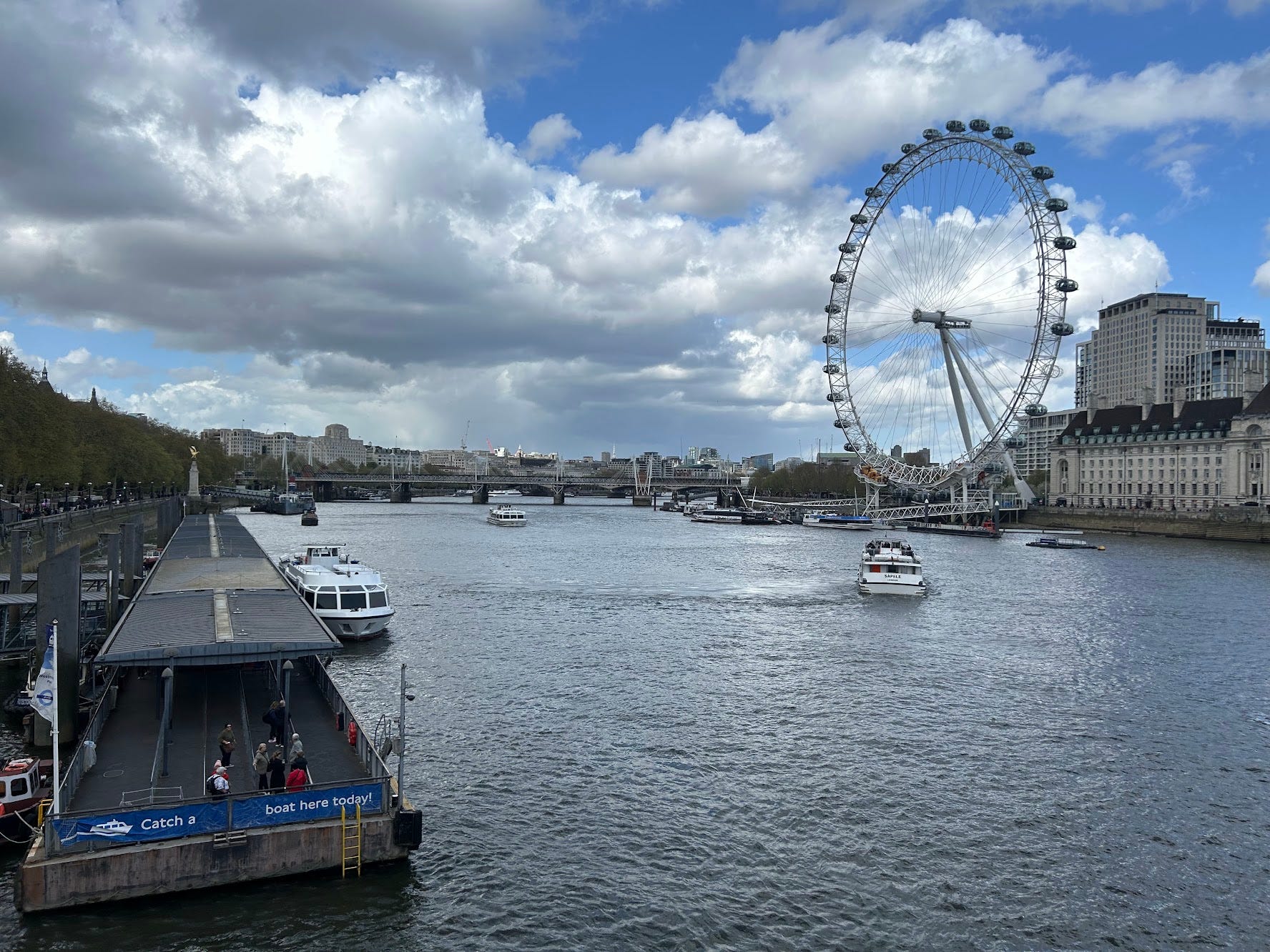
The Thames.
Wide, dark, beautiful —
criss-crossed by bridges,
resplendent in reflected city lights.

Lifeline of commerce. Tourism. Leisure.

But beyond this river-as-resource —
who is she?

Meet Tamesis.
The Dark One.
Goddess of the Celts
who received bent swords, jewellery, human skulls
that archaeologists are still finding —

the wide, flowing one
who carried grief and devotion
in the same current.

Until — et voilà — she became he.

Like so many of her predecessors,
modern era erased Tamesis.
Replaced her with Old Father Thames.
Masculine. Civic. Managed.

Commercial artery. Strategic asset.

Potted river.

She, like the Oracle of Delphi,
no longer speaking for the Python,
but for the god of light, Apollo.


O Tamesis, Tamesa —
I know your kind.

Tamas in my language too means Dark.
Like my mother, Kali.
Revered and feared as Tamasic.
Before modernity split apart
good from bad,
light from dark,
invocation from lamentation.

No wonder the Indians of London still worship you,
because they too have known and loved
river goddesses back home.

I, daughter of Padma in today's Bangladesh,
sister-lover of East River
who watches over me
in my adopted home in New York —

I stand here today on your embankment
in April rain,
calling you by your true name.


O Dark One!

You have received a thousand invocations,
a million lamentations —

Voices trembling in awe, in wonder
as a new day washes away the stains of the old one.

Raw grief pouring from the bowl of other voices,
naming what must be named.
For there is power in naming.

Both trusting that you will hear.
And that you will take tender care of what is offered
into your safekeeping.


Today, contained by hardened embankments,
commodified for our hubristic projects,
you still flow.

Wide. Meandering.
Holding secrets in your dark depths.

As sun and clouds play hide-and-seek
over London skies,
I bow to you.

I see you.

And I choose to call you
by your ancient name.
Your true name.

Tamesis.
Tamesa.

O Dark One.
O Wide, Flowing One.

Please, bless us.
This heartbreakingly beautiful species,
so bent upon its own undoing.
Notes
On the naming of the Thames
The river’s oldest recorded name is Tamesa or Tamesis, from the Brythonic Celtic — meaning the dark one, or sometimes translated as wide and flowing. In Celtic belief, river spirits were understood as female; Tamesis was a goddess, a living entity of life, fertility, and boundary-keeping. She received offerings: bent and broken swords, jewellery, human skulls — grief and devotion too large for land to hold.
The upper Thames, near Oxford, retains the name Isis — itself associated with goddess-worship of natural waters. By the 18th and 19th centuries, however, the river had been re-personified as Old Father Thames: masculine, civic, managed. The same river. A different theology entirely. The goddess went underground with the goddess-worshippers.
Potted river is a phrase that arrived in conversation on the banks of the Thames, April 2026 — a description of what happens when a wild waterway is embanked, made navigable, stripped of its original wildness for the convenience of those who would use it. It named something older than infrastructure.
On the Padma and the Bay of Bengal
The Padma is one of the main distributaries of the Ganges as it moves through Bangladesh toward the sea. Sacred, ancient, flood-prone, and ungovernable, it has shaped the landscape, the agriculture, and the imagination of Bengal for millennia. It empties into the Bay of Bengal — the largest bay in the world, warm-watered, cyclone-bearing, ecologically extraordinary.
To carry the Padma in the blood is to carry a particular kind of water-memory: one in which rivers are not managed amenities but living presences. In Bengali Shakti traditions, water is inseparable from the feminine divine — Durga’s arrival and departure are marked by immersion in the river; Kali stands at the burning ghat at the water’s edge. The sacred and the flood are not opposites.
On the East River as daily witness
The East River — technically a tidal strait, not a river — runs between Manhattan and Queens/Brooklyn, visible from Roosevelt Island. It moves every morning, tidal and particular, carrying light differently depending on the season, the hour, the weather. To call it sister is not metaphor. It is recognition of kin: dark water, feminine, flowing through a city that has largely forgotten what it was.
📅 Join me in person or on zoom
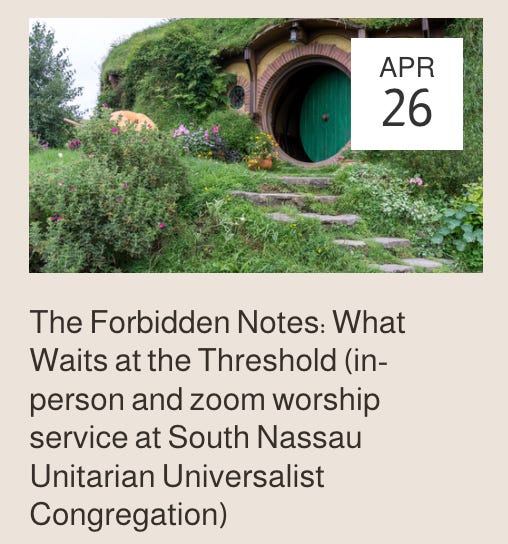
The Forbidden Notes: What Waits at the Threshold
A worship service at South Nassau Unitarian Universalist Congregation (SNUUC)
April 26, 2026 · 10:30 am ET (zoom information linked above)
We are each caretakers of many worlds — inner and outer. Some we know intimately, others less so. Rumi reminds us: “the door is round and open.” What might we see and hear if we visited the threshold often and conversed with who we find there? That will be our meditation this Sunday.
🌍 The Cost of These Words
This poem lives on servers cooled by redirected water, powered by grids fed through extraction. Reading this poem carries environmental cost: approximately 1.76g CO₂ per view. Our electronic comforts and convenience depend directly on often-dangerous and always-undercompensated labor in the Global South.
To reduce impact: Read and share mindfully | Let this piece settle before moving on to something else
Resources for unlearning and repair: Gesturing Toward Decolonial Futures
Wow rivers are so much a part of your life! I love the reminder about the feminine goddesses and how they have been renamed but still remain with us underground….there is mighty power underground!!