Some trees have dropped their leaves now.
Others hold on—still green, still dressed,
or just beginning to turn.
But the bare ones—
they reveal what was always there:
hidden sculpture,
each tree’s particular reach and angle,
the way this one forks low and wide
while that one shoots straight up
before it branches.
When clothed, we call them “a stand of trees.”
Collective. Similar.
The way abundance makes us blend.
But naked, each becomes utterly itself—
singular architecture,
unrepeatable geometry,
the specific grammar
of this life’s reaching.
***
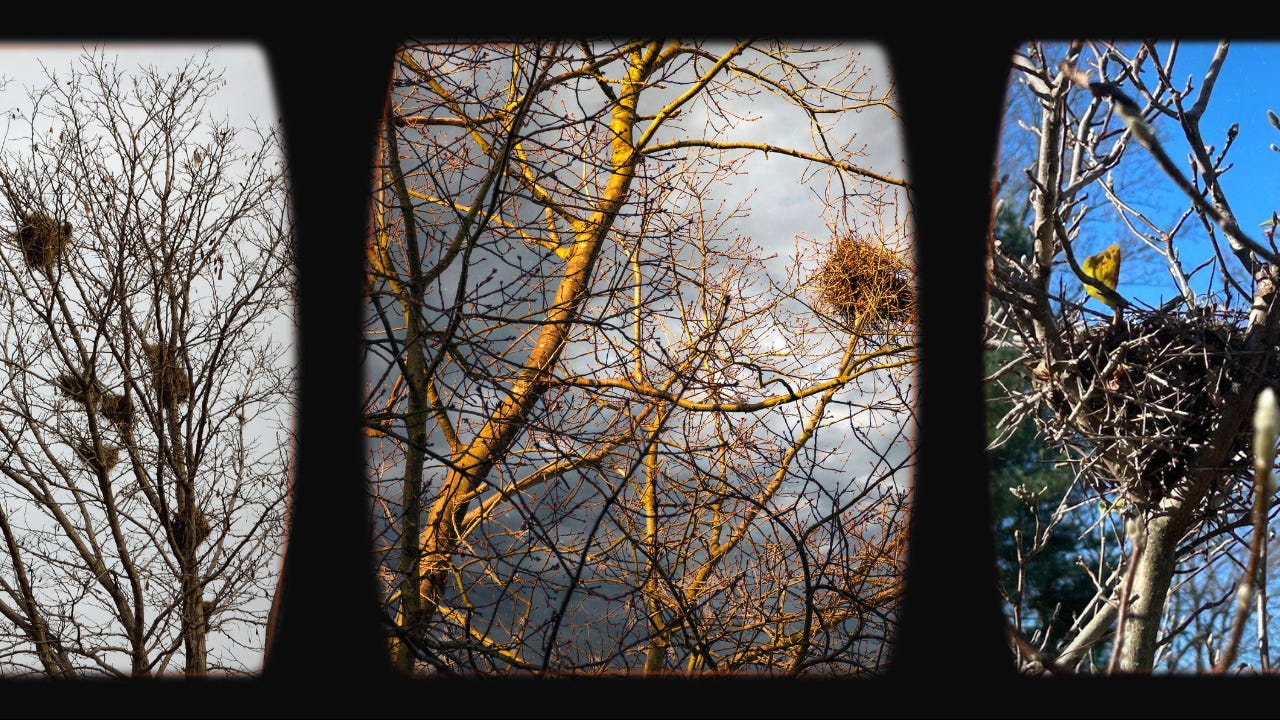
And there, at the junction of bare branches,
high up where summer hid them:
abandoned nests.
Woven cups that held eggs once,
held fledglings,
held the fierce attention
of making shelter.
Now just held.
I wonder: will the weavers return next spring
and renovate these?
Or will they build fresh elsewhere?
What happens to abandoned nests?
How do they become part
of the cycle of creation and decay
that is all life?
The branches bear them all
without ceremony,
without sentiment.
Was this a nest where all eggs hatched?
All fledglings flew?
Or was it the one shaken askew by the storm?
Raided by the bird of prey?
What particular stories does this nest hold?
And this one?
And this one?
I can’t know.
Nothing marks them as distinct, unique.
No achievement awards here.
No gravestones.
And so they become canvas
for any story.
Every story.
They simply hold
what remains.
***
We’re in unnamed time now.
Halloween’s threshold closed.
Día de los Muertos altars dismantled.
Thanksgiving not yet pulling us forward.
Just the steady shortening of light,
the growing chill,
ordinary Tuesdays no one will remember.
This is profane time—
pro fanum: outside the temple.
Before the temple.
The ground on which it stands.
We’ve been taught to hear “profane”
and think: vulgar, distasteful,
everything the sacred isn’t.
But what if we got it wrong?
***
Imagine a temple.
The inner sanctum—
dim, exclusive,
reserved for those with the right pedigree,
the proper chants,
the money to buy access.
You can only enter
when the time is just right.
And after the faithful leave,
it needs to be cleaned,
cleansed of all that the profane
tracked in.
Sacred is meant to remain aloof.
Pristine.
Just so.
And then the courtyard:
The wide space before the temple doors
where a mango tree spreads shade
for weary pilgrim and stray dog alike.
Where anyone can sit.
Where beggars hold their bowls
and children play
and someone sings.
This is profane space.
No special permission needed.
No credentials required.
The ground that holds everyone
the temple excludes.
***
These unmarked November days—
they’re courtyard time.
Profane time.
Not the inner sanctum
of named holidays,
of ceremonies that require
the right words,
the proper preparation.
Just the wide open space
where we all stand,
where the ordinary mingles
with the ordinary,
where nothing is consecrated.
Or is everything?
***
What if the quotidian is holy ground—
all you have to do is stop and look.
At the line of ants
crawling from tree trunk
to abandoned morsel.
At the bright pink ribbon
that clearly fell from a child’s hair,
now quivering in the breeze.
At the soft snore
of the pilgrim who has walked days
to arrive here,
who has fallen asleep waiting
for the temple doors to open
for evening prayers.
The unremarked magic of every moment,
held in the courtyard
where no one checks credentials,
where the stray dog and the holy man
share the same shade.
***
The darkness of this mid-November day isn’t symbolic.
Not the new moon of Kali Puja.
Not the magic of Samhain.
Not winter solstice’s mystical dark,
pregnant with return,
the birth of the Christ child.
Just dark.
Dark when I make morning tea.
Dark again by dinner.
Practical darkness
that resists grand meaning-making,
refuses to be precious.
And yet—
***
When chill deepens outside,
interior attention emerges.
Not retreat.
A different threshold.
The apartment becomes vessel.
I light wood-wick candles—
not because anyone told me to,
not because it’s written in any liturgy,
but because growing dark
makes small flames matter,
and these ones crackle
like a real fire,
like a fireplace I don’t have,
their wooden wicks making
the sound of burning.
I pour wine—dark, brooding,
notes of earth and tobacco—
and it becomes ritual.
Not ceremony prescribed
by temple or tradition,
but the kind we make
when we pay attention
to what the season asks.
***
Warmth. Flavor.
Candlelight catching in dark red.
The radiator’s steady heat.
Weight of blanket.
Lamp making its circle of light
in the long evening.
These ordinary things take center stage
not because we’ve elevated them
but because November strips away
the competition.
***
Maybe the spiritual work
of mid-November
is learning to honor
what doesn’t ask to be honored.
To tend unmarked days
with the same attention
we bring to ceremonies.
To find that profane ground—
this specific evening,
this particular tree’s branching,
this glass of wine
that’s just a glass of wine—
is enough.
Not because we’ve made it sacred,
but because we’ve finally stopped
needing to.
Etymology Note:Profanus: Latin, from pro (before, outside) + fanum (temple). Originally meaning simply “outside the temple”—not unholy. The ordinary ground on which temples stand. The everyday life beyond precincts marked sacred. The necessary foundation that holds all our extraordinary moments.
I really love your musings. In a world where headlines scream at us from every direction, a world of distraction from what is always right there, around us, the ordinary, the profane, this is a point of stillness. Noticing a nest that has served its function for the season, noticing the winter skeletons of trees, nothing "sexy" but still noteworthy and reflecting the now, the reality that doesn't mislead us into clickbaits.


Thank you for this, so much of it expresses how I feel about this time of year. Beautiful!
"Maybe the spiritual work
of mid-November
is learning to honor
what doesn’t ask to be honored."
I really love your musings. In a world where headlines scream at us from every direction, a world of distraction from what is always right there, around us, the ordinary, the profane, this is a point of stillness. Noticing a nest that has served its function for the season, noticing the winter skeletons of trees, nothing "sexy" but still noteworthy and reflecting the now, the reality that doesn't mislead us into clickbaits.